
Our research · August 14, 2026
California's Rules for Unclaimed Crypto
California Crypto Unclaimed Property: Why Coinbase, Robinhood, Binance.US, Kraken and Gemini May Send Your Crypto to the State
California now has a law that sends untouched crypto to the state. The thing that stops the clock is simpler than almost anyone assumes: logging in.
Think something of yours is already with the state?
We will search on your behalf, including under previous names and addresses you may not think to check. No upfront fees — we are only ever paid out of what we actually recover.
Check for unclaimed fundsThe short version
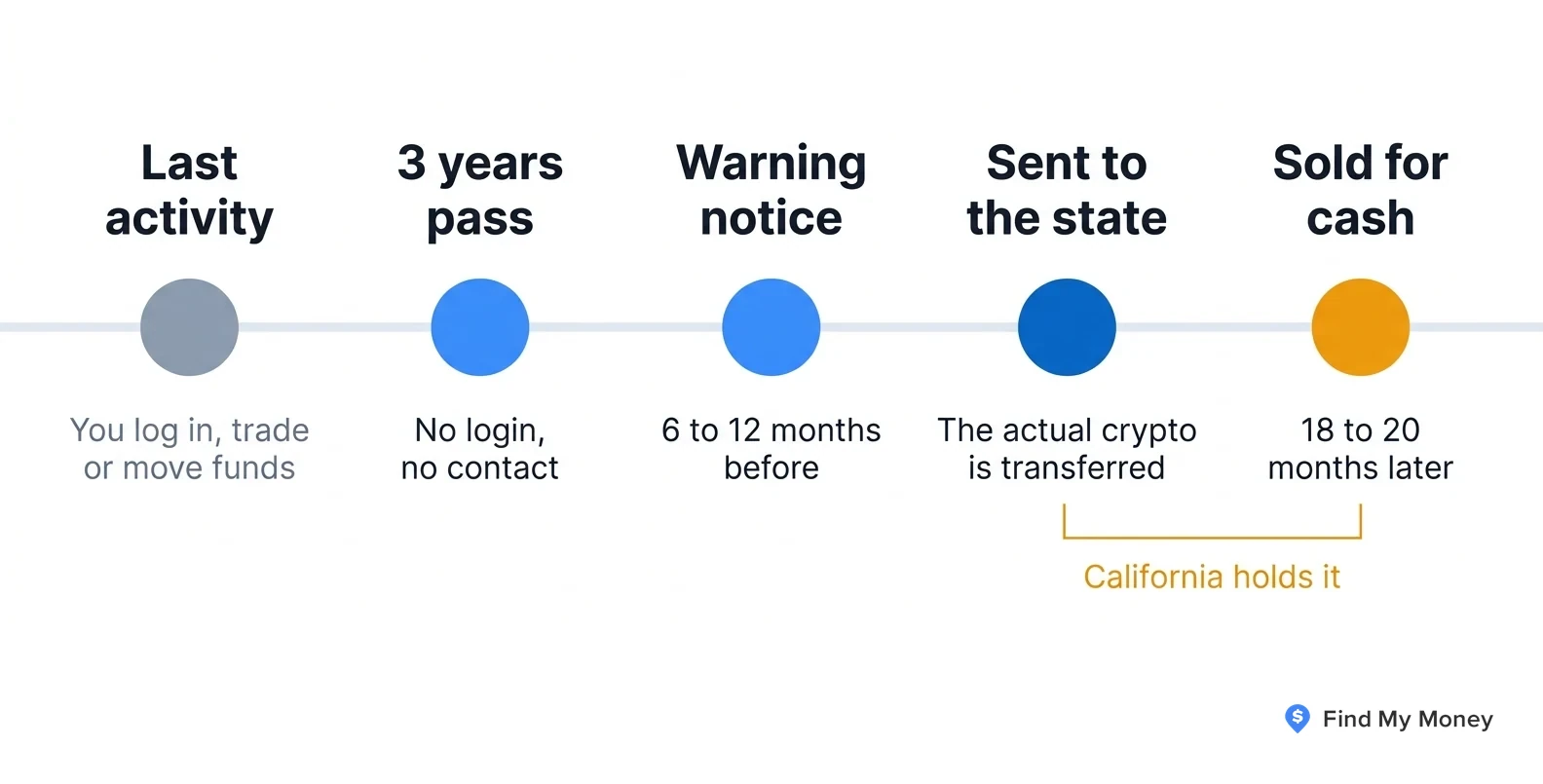
If your crypto sits on Coinbase, Robinhood, Binance.US, Kraken, Gemini or any other platform that holds the keys for you, and you go three years without touching the account or answering the company's messages, California law now requires that platform to hand your actual coins over to the state. The state then has to sell them, on a fixed schedule, roughly a year and a half later.
You can still get your money after that. What you cannot get back is the coins — or whatever they went on to be worth. That is the whole risk in one sentence, and it is why the timing of a claim matters far more with crypto than it ever did with a forgotten bank balance.
The legal word for this is escheatment. If you have had a letter using that word, this page is about the same thing. We will say “sent to the state” from here, because that is what happens.
The law is here. Nothing has moved yet.
Senate Bill 822 was signed in October 2025 and took effect on January 1, 2026. It is current, operative California law, not a proposal.1
But no crypto has actually reached the state, and none is due to until around December 1, 2026. That is the date worth knowing. Exchanges file their annual reports with California by 31 October, and the crypto rule gives them 30 days after that to send the assets themselves.2
Crypto jumps the queue. The cash, checks and shares reported in that same batch do not reach the state until the following June — roughly six months later. Only crypto moves on the fast timetable.3
And the other end is not built yet
As of this writing California had not named the custodian that will actually hold the crypto, and had published no guidance telling exchanges how to report it — its most recent instructions to companies predate the law entirely. In April 2026 the state was still hiring consultants to write the procedures, for this reporting season.4 So: a firm deadline a few months out, and a receiving system still under construction. We will update this page as it lands.
Three years of what, exactly
“Three years of inactivity” is the shorthand, and it is not quite what §1516.5(a) says. There are two different starting guns, and which one applies depends on whether the exchange can tell that its messages to you are bouncing.
| Situation | The three years run from |
|---|---|
| The exchange sends you post or email and can see when it comes back undelivered | The date that message was returned undelivered — by the Postal Service, by email, or by whatever messaging method was used |
| You do not receive its messages at all, or it has no way of systematically tracking whether they were delivered | The date you last did something with the account |
The second row is not a free-standing alternative, which is how it is usually summarized. It only applies in those two circumstances. In practice that matters because a well-run exchange that emails you and tracks bounces is on the first row — so a delivered email you never opened does not, by itself, start anything.
Logging in is enough
This is the single most useful thing on this page, and it is the part most coverage buries. §1516.5(c) sets out what counts as an “exercise of an act of ownership interest,” and the list is unusually generous:
- A transaction — buying or selling crypto, or moving cash or other property in or out, whether one-off or on a standing instruction you set up earlier
- Electronically accessing the account. Logging in. That is the whole requirement.
- Activity in any other account or property you hold with the same company — so trading stocks at a platform that also holds your crypto counts
- Anything else that reasonably shows the company you know the property exists — the list is written as “includes,” not as a closed set
Separately, a documented conversation with the exchange stops the clock too — so a support ticket counts, if they keep the record.5
The practical consequence: a long-term holder does not have to sell anything to stay safe. Someone who bought Bitcoin in 2017, has deliberately never touched it since, and whose exchange can still reach them is not, by that fact alone, heading for a problem — on that track the clock only starts when a message bounces. Someone who bought in 2017, moved house twice, changed email once and has not logged in since is in a different position entirely. Reachability, not trading, is what separates them.
The letter that has to come first
Before any of this happens, the exchange has to write to you — no less than six and no more than twelve months before the crypto becomes reportable.
If it has a mailing address for you in its records that it does not know to be wrong, the notice must go by certified mail, return receipt requested. Email is not an alternative in that situation. Electronic notice is only permitted where the company has no mailing address for you and you have previously consented to electronic service — both conditions, not either.
The notice has to tell you what is at stake, in a prescribed format: when your interest in the property was last recorded, an identifier for the asset, the danger that it goes to the state, and the three-year rule. It also has to include an address-confirmation form in the format the Controller prescribes. Sending that form back restarts the period. So does a documented phone call.
There is no small-balance exemption
$50 gets repeated as though it were a crypto threshold. It is not. It is the floor for the holder's pre-transfer notice under the general catchall rule in §1520 — and SB 822 amended §1520 to carve digital assets out of that catchall entirely. The notice provisions inside §1516.5 have no value threshold of their own.
We read §1516.5 in full and there is no dollar figure anywhere in it. §1533, which lets the Controller decline to take custody of property, reaches only tangible personal property — SB 822 amended that section but left the tangible-only limit alone. There is, on the face of the statute, no mechanism to refuse a small crypto balance.
A separate $50 rule does survive, and it works in your favor: §1531(b) requires the Controller to write to the owner of any property worth $50 or more once it has been reported. That is the state's own letter to you, not a test of whether your crypto was reportable in the first place.
What happens once it leaves the exchange
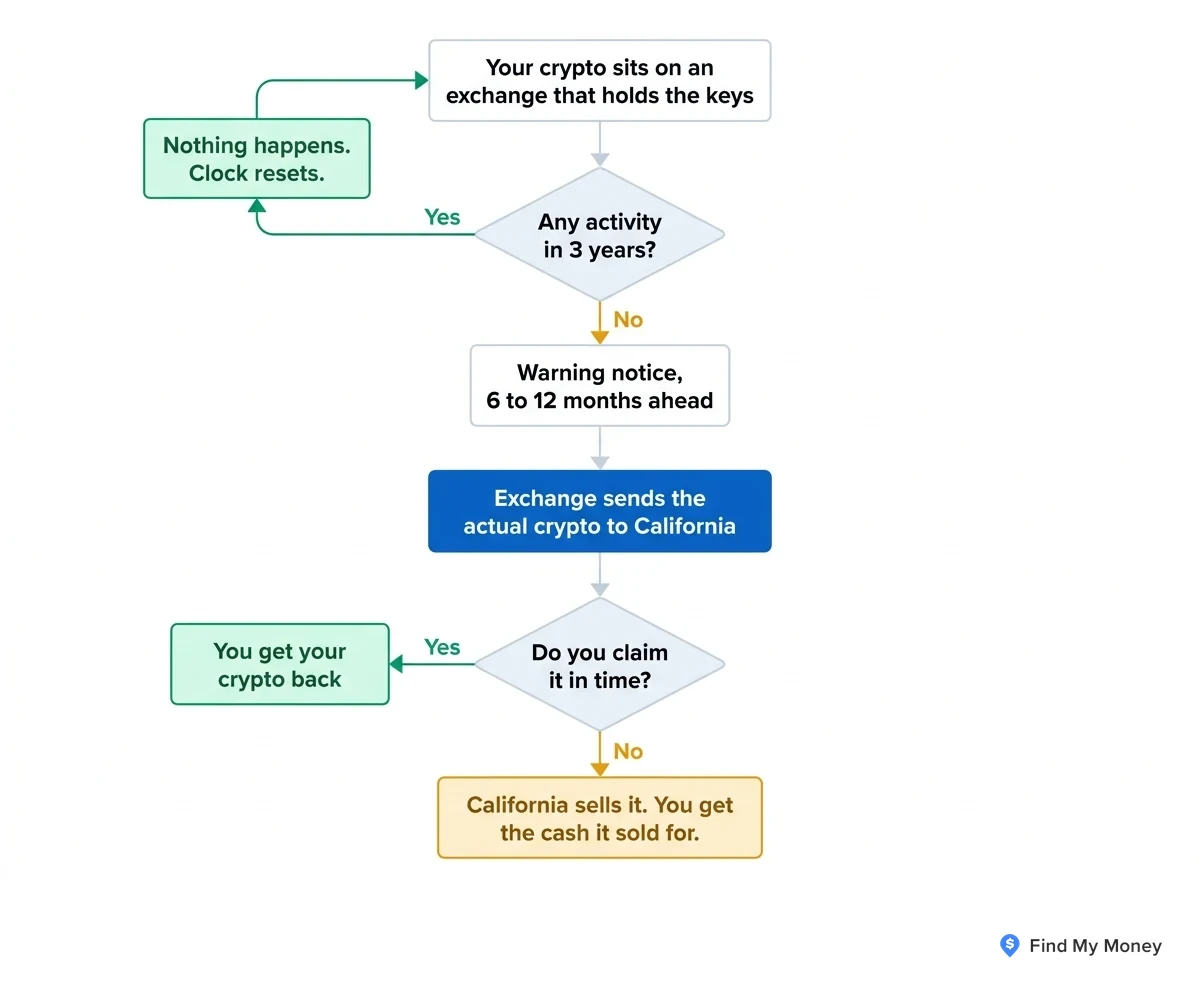
§1532(e) requires the holder to transfer the exact asset type, the private keys and the exact amount, unliquidated. The state receives the crypto itself rather than its dollar value.
Where a company holds only part of a multi-key arrangement, it has 60 days from the point the asset is determined to be eligible to assemble the minimum number of keys needed to move it, and holds and maintains the asset until it can.6
The receiving custodian must hold a license from the Department of Financial Protection and Innovation. §1568 lists eight factors the Controller weighs in selecting one, covering storage security, private-key management, experience, regulatory compliance, reporting, owner reunification and anti-money-laundering status.7 The Controller may select one or more custodians. None had been named when we published this.
Then California converts it to cash
§1563(c) sets the timing: the Controller shall convert digital financial assets to cash no sooner than 18 months and no later than 20 months after the report is actually filed. The method and pricing are at the Controller's discretion. The timing window is not.8
That leaves roughly a year and a half, measured from the filing date, in which the state holds the asset in its original form.
Claim inside the window and you get your crypto. Miss it and you get dollars.
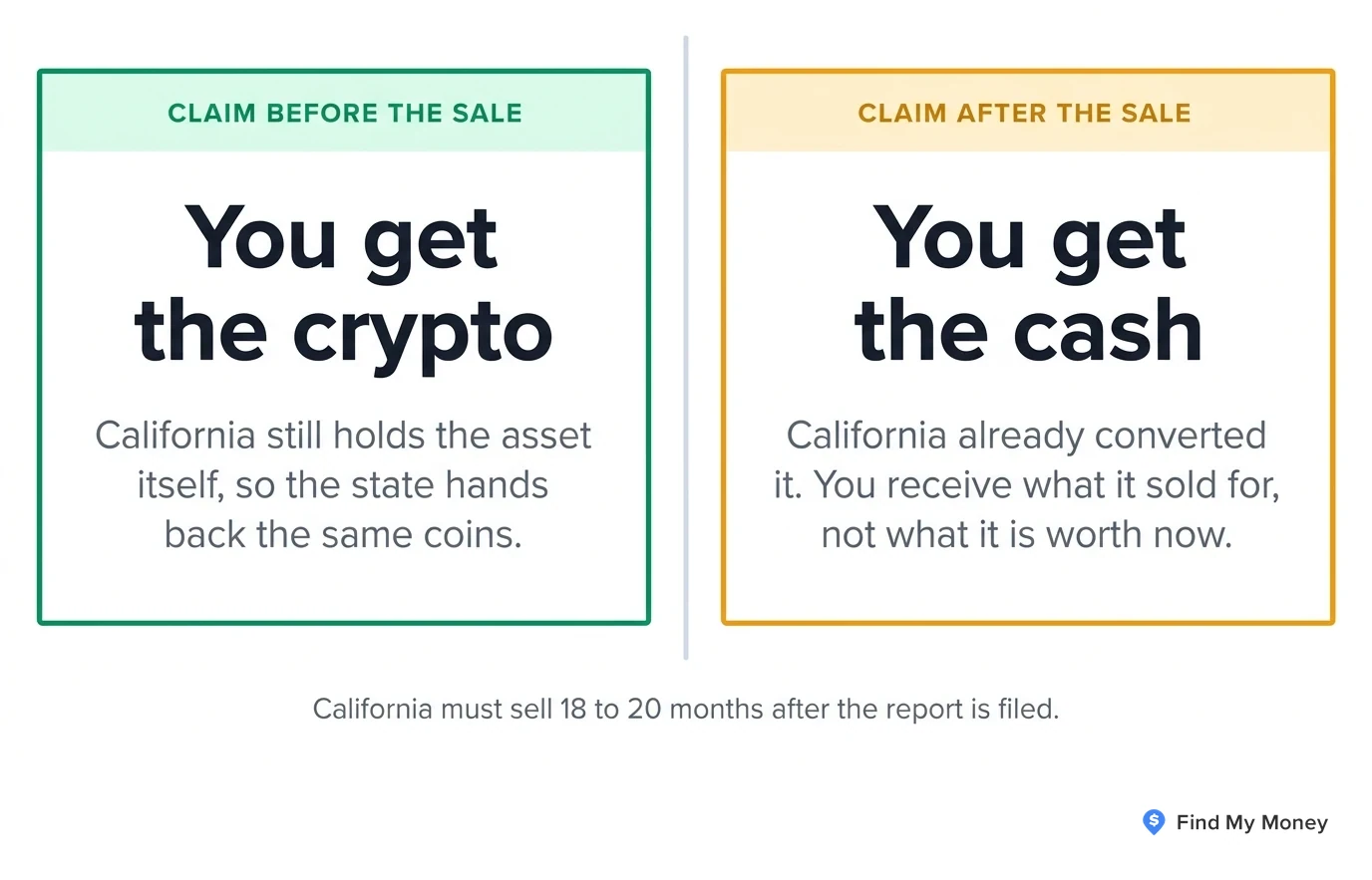
§1563(c) is explicit about both halves. If the assets are still in the Controller's custody when your claim is validated, you are entitled to receive the digital financial assets. If they have been converted, you are entitled to the net proceeds the Controller received from the sale.
With a forgotten current account, that distinction is meaningless — cash stays cash. With an asset whose price can move by a large multiple between the report and the claim, it is the entire story. Ninth Circuit precedent makes recovering the difference very hard: owners are “not entitled to more than the actual property that the State took into its possession or the proceeds of that property.”9
This has already happened, at scale
It would be easy to read all of this as a hypothetical about a law that has not been used yet. It is not.
In the spring of 2024, as WyoFile reported in August 2025, Coinbase closed “perhaps a quarter-million customer accounts across 139 different countries” — upwards of 200,000 international customers — sold the crypto in them and, acting through a newly formed Wyoming corporation, sent roughly $270 million in proceeds to the state of Wyoming. Jeff Robertson, who leads the State Treasurer's unclaimed property division, told the outlet that the state's fund “basically tripled overnight.” More than a million individual properties came across, and 22 customers were owed over $1 million each. As of that reporting, upwards of $230 million was still sitting unclaimed against roughly $35 million paid out. The Treasurer runs a dedicated Coinbase page, which answers the obvious question bluntly: “Our government does not allow us to make payment with crypto/virtual currency.”
More recently, and much smaller: Connecticut's Department of Banking entered a consent order against BAM Trading Services, trading as Binance.US, in June 2025 — requiring it to stop trading within 60 days, convert customers' remaining virtual assets to fiat, mail a cashier's check to each last known address, and remit whatever went unclaimed to the State Treasurer. Binance.US duly disabled trading after August 22, 2025, mailed checks in September that expired on December 17, 2025, and told customers the balance would sit with the Connecticut Treasurer's unclaimed property division from January 20, 2026 onwards. There, the conversion was a regulator's requirement rather than a company's preference.
Both of those followed the old pattern — sell first, send cash. California's design is the opposite, and that eighteen-month window in which the state holds the asset itself is, for an owner, the most valuable thing in the statute. It is also the thing that quietly expires.
What the five biggest custodial platforms actually say
All quotes below are from the companies' own current user agreements, help centers and SEC filings, checked in August 2026. This covers hosted accounts only — the ones where the platform holds the keys.
| Platform | Who holds the keys | What it says about dormancy | How it says it will warn you |
|---|---|---|---|
| Coinbase | Hosted wallet assets are “custodial assets held by Coinbase for your benefit”; title stays with you; Coinbase “shall retain control over electronic private keys” and mayuse shared addresses, under a section headed “Omnibus Accounts” | Dormancy periods “typically 1–5 years depending on the state and asset type”; inactivity is “generally determined by a lack of activity or contact from you, such as not signing in” | Notifications by email or physical mail before transfer, as state rules require |
| Robinhood Crypto | “we don't provide customers with the private keys”; its 10-K describes custody in omnibus wallets. The separate Robinhood Wallet is self-custody and outside all of this | Publishes no single nationwide period — “different states and US territories have different rules on how long an account must be inactive”. Cash, equities and crypto all in scope | Email and/or a physical letter stating “the date by which you have to log into your account” |
| Binance.US | Assets “beneficially owned by you” which “may be held in one or more omnibus wallets (either hot or cold storage as determined solely by BAM)” | “typically considered Unclaimed Property after 2–5 years”; warns it may convert crypto to USD, that this can be taxable, and reserves a dormancy fee | No fixed published cadence; has run the process in practice, in Connecticut |
| Kraken | Assets “held in custody by us for you”, title remains with you; Kraken “may use shared blockchain addresses, that we control” | “If you are inactive for a protracted period” it may be required to report and remit, and notes state law “may require liquidation” | No platform-specific notice cadence published. California's statutory notice applies regardless |
| Gemini | Gemini Trust Company is a New York fiduciary and qualified custodian; you retain full title. Its separate self-custodial Gemini Wallet is outside this | If an account is closed or dormant long enough it “may be required, upon the passage of applicable time periods, to report any remaining funds… as unclaimed property”; reserves an administrative fee | “reasonable efforts to give Written Notice”, then seven business daysto respond “or as otherwise required by law” — which in California means the statutory 6-to-12-month notice |
Two patterns run through all of this. Three of the five — Coinbase, Binance.US and Kraken — say in their own documents that unclaimed property law may require the crypto to be sold for dollars before it is handed over. That is the national default, and it is exactly what California's §1532(e) overrides for California property. And two of them, Binance.US and Gemini, reserve a dormancy or administrative fee against the balance on the way out.
It is worth saying plainly: none of this means these companies have done anything wrong. Reporting property they cannot return is what the law requires of them. Coinbase has told the SEC in its annual report that unclaimed property laws may require it to turn over customer property “including airdropped tokens and forked crypto assets,” and that there is “significant regulatory uncertainty with how certain states and foreign jurisdictions treat crypto assets under unclaimed property rules.” That is a candid description of the problem, not an admission of one.
What this does not cover
- Self-custody. If the keys are on your hardware wallet or in your own software wallet, there is no holder to report you and nothing for anyone to hand over. California cannot compel a company to produce a key it never had. This is the clearest line in the whole area.
- Most NFTs, and tokenised securities. §1516.5 borrows its definition of “digital financial asset” from Financial Code §3102(g), which excludes securities registered with — or exempt from registration with — the SEC, and securities qualified with or exempt from qualification with the DFPI, and which also excludes digital records of ownership of goods: art, music, collectibles, in-game items, virtual land, loyalty points, licenses, tickets. Those sit outside the crypto rules. They are likely still caught by the general catchall in §1520 instead, which keeps the $50 notice floor and the ordinary June remittance date.
- Not excluded: stablecoins. They are not on the exclusion list.
One consequence of how §1501(d) is drafted is that it points at the Financial Code definition rather than copying it, so the scope of the crypto rules moves whenever that definition is amended. It was last changed in June 2026.
What to actually do about it
The cheapest claim is the one that never becomes a claim. In rough order of usefulness:
- Log in once a year, on purpose. Put it next to something you already do annually. Under §1516.5(c) that alone is an act of ownership. You do not need to trade.
- Fix the address and email on every exchange account you have ever opened. Including the one you stopped using. The undelivered-message trigger is the one that catches people who have moved, and it runs whether or not you would have wanted the message.
- Do not ignore a letter that mentions unclaimed property. Returning the enclosed confirmation form restarts the period outright. It is the single highest-leverage envelope you will get from an exchange.
- Keep the paperwork. Account statements, historical emails, tax forms, deposit and withdrawal transaction IDs, the addresses associated with the account, identity documents, and — for an estate — the death certificate and letters of administration. California asks for proof of both identity and ownership, and the documentation requirements are specific.
- Never hand over a seed phrase or private key to prove who you are. Not to a recovery firm, not to anyone who calls you about this. For custodial crypto it proves nothing — the exchange or the state holds the keys, not you. A request for one is a reliable sign of a scam.
If an exchange has already written to you, it is far easier to sort out before the report goes in than after. Once the crypto is with the state, the clock on the sale has started.
And to be clear about what is and is not urgent here: California holds unclaimed property indefinitely, and there is no deadline to claim it. Your money does not expire and the state does not get to keep it. The only thing on a clock is the form the property comes back in — coins before the sale, cash after. That is the whole of the time pressure, and anyone telling you otherwise is selling something.
Questions people actually ask
Can cryptocurrency really be handed over to California?
Yes. Senate Bill 822, signed in October 2025 and in force since January 1, 2026, added Code of Civil Procedure §1516.5, which puts "digital financial assets" held by a business association squarely inside California's Unclaimed Property Law. It applies to crypto held for you by a custodial exchange — a platform that controls the private keys. It does not reach a wallet whose keys only you hold.
How long does a crypto account have to sit idle?
More than three years. The clock runs either from the date a message to you came back undelivered, or — if you do not receive the exchange's messages, or it cannot systematically track whether they bounced — from the last time you did something with the account.
Does logging in stop the clock?
Yes. §1516.5(c) lists "electronically accessing the digital asset account" as an exercise of an act of ownership interest, alongside trading, depositing, withdrawing, and activity in any other account you hold with the same company. You do not have to sell anything to prove you are still there.
Will Coinbase or Robinhood warn me first?
The law requires it. A notice must go out no less than six and no more than twelve months before the crypto becomes reportable. If the exchange has a mailing address for you that it does not know to be wrong, the notice must go by certified mail, return receipt requested. Electronic notice is only permitted where there is no mailing address on file and you have consented to electronic service.
Is there a minimum balance below which crypto is safe?
No. §1516.5 contains no dollar threshold. The $50 figure people cite comes from the general notice rules, which §1520 expressly does not apply to digital assets, and the $2,000 figure is about how holders wire cash to the state, not an exemption.
Does California sell the crypto?
Eventually, yes — and it is not optional. §1563(c) says the Controller shall convert digital financial assets to cash no sooner than 18 months and no later than 20 months after the report is actually filed. What SB 822 changed is that the exchange has to send the asset itself rather than cashing it out first, which buys you a window of roughly a year and a half.
Can I get the actual Bitcoin back?
If you claim while California still holds it, yes — §1563(c) entitles you to the digital asset itself. If it has already been converted, you are entitled to the net proceeds of that sale instead.
If the price goes up after California sells, can I claim the difference?
Ninth Circuit precedent makes that very hard. In Suever v. Connell the court held owners are not entitled to more than the property the state took or the proceeds of it. In 2025 a panel applied that reasoning to reject exactly this argument from an owner whose Amazon stock California had sold — in an unpublished memorandum, so Suever remains the governing rule rather than that decision. Either way, it is why the timing of a claim matters more with crypto than with cash.
Does this apply to my hardware wallet or MetaMask?
No. California can only compel a company that holds the keys. If you hold your own keys, there is no holder to report you and no key for anyone to hand over.
Do I have to pay anyone to get it back?
No. California's search and claim process is free at claimit.ca.gov, and the State Controller states plainly that owners are not required to use an investigator. If you do use one for California property, the fee is capped at 10% and cannot be collected before the state approves and pays the claim.
Notes
- 1.SB 822 is Chapter 660 of the 2025 statutes, approved by the Governor and filed with the Secretary of State on October 11, 2025. It added two sections to the Code of Civil Procedure — §1516.5, which does the work, and §1568, which sets the rules for whoever holds the state's crypto — and amended five more, including the definitions section and the two provisions governing how and when property reaches the Controller. ↩
- 2.§1532(e) gives the holder “no more than 30 days after the final date for filing the report required by this section” to transfer the asset. One honest caveat, since we have not seen it worked through anywhere else: §1532 does not itself impose a report — §1530 does, and §1532(a) refers back to it. Read the obvious way, the 30 days run from the October 31 notice-report deadline, which the Controller's own April 2026 procurement documents confirm for 2026. Read hyper-literally, the cross-reference has no antecedent. We think the first reading is plainly right; it is exactly the sort of thing regulations are meant to settle, and there are none yet. Life insurers file on a different calendar. ↩
- 3.§1532(a) sets ordinary remittance at “no sooner than seven months and no later than seven months and 15 days after the final date for filing the report” — which, off a October 31 deadline, works out to the back half of the following June. ↩
- 4.No custodian has been announced under §1568. The newest item on the Controller's Notice to Holders page dates from 2023; the Holder Handbook is still the September 2024 edition; and the Unclaimed Property Law and Regulations booklet, updated February 2026, reprints §1516.5 and §1568 with no implementing regulations attached. The office issued a request for information on unclaimed cryptocurrency asset management in October 2025 (UPDRFI0125), and a request for proposals for digital-financial-asset consulting in April 2026 (EUPD90926), scoped to “promptly integrate the developed and needed standard operating procedures into the current unclaimed property holder reporting period for 2026.” The reporting plumbing is further along than the custody side: NAUPA's file format now carries virtual-currency property codes — VC01 for native units, VC02 for liquidated, VC03 for a cash balance — plus a cryptocurrency element with blockchain and contract-address fields. ↩
- 5.§1516.5(b). Two drafting quirks, for anyone reading the statute themselves. The stop-the-clock sentence is written to attach only to the first of the two triggers, not to both. And subdivision (h) cross-refers to “subdivision (b) or (c)” when the notice duties it means actually sit in (e), (f) and (g) — the same slip is repeated in the amended §1520(b). Both read as errors rather than design, but they are the sort of thing that gets argued about later. ↩
- 6.§1516.5(i) sets the 60 days, running from the determination that the assets are eligible. §1532(e)(2) directs the holder to maintain the asset until additional keys become available or it is otherwise able to transfer. Neither provision requires a sale. ↩
- 7.§1568(a) requires a license under Financial Code §3201 et seq. §1568(b) lists the eight factors: storage security including robust cybersecurity; capability to manage private keys and ensure the ability to transfer and transact; proven experience handling digital financial assets; compliance with applicable federal and state custody regulations; regular reporting to the Controller on status and value; processes to reunite owners with their property, including updated contact records and timely notifications; qualifying as a financial institution under 31 CFR Chapter X and subject to Bank Secrecy Act anti-money-laundering obligations; and any other factor the Controller deems relevant. ↩
- 8.§1563(c) contains both verbs. The Controller mayconvert “at prevailing prices by any method that the Controller may determine to be advisable” — that is the discretion over method. The next sentence says the Controller shall convert inside the 18-to-20-month window. Note that the window runs from the actual date of filing, not the final date it was due, so a holder that files early starts the clock early. ↩
- 9.Suever v. Connell, 579 F.3d 1047, 1059 (9th Cir. 2009). A 2025 panel applied it to reject exactly this argument from an owner whose Amazon stock California had sold, calling the claim “plainly foreclosed” — but that decision is an unpublished memorandum and is not itself precedent, so Suever remains the governing rule. Separately, in Garza v. Woods(2025) the same court threw out a takings claim against Arizona's unclaimed property regime but allowed a due-process claim to proceed where the owners plausibly alleged the notice they received was constitutionally inadequate. The settled point is narrow: it concerns what an owner can recover after a lawful sale, not whether the state may take property without notice. ↩
Sources
All checked in August 2026. The statute and the Controller's own publications are what the law requires and how far the state has got with implementing it. The platforms' user agreements, help center articles and SEC filings are what each company says it does. The rest is what has happened in other states.
The statute
- SB 822 (2025), Chapter 660 — chaptered text Approved and filed October 11, 2025. Adds CCP §§1516.5 and 1568; amends §§1501, 1520, 1532, 1533 and 1563.
- CCP §1516.5 — when digital financial assets escheat, and notice to the owner
- CCP §1532 — delivery to the Controller (subdivision (e) is the crypto rule)
- CCP §1563 — sale of escheated property (subdivision (c) is the 18-to-20-month window)
- CCP §1568 — custodians of digital financial assets
- CCP §1501 — definitions, including “digital financial asset” and “private key”
- CCP §1520 — the general catchall, now excluding §1516.5 property
- CCP §1530 — the annual holder report and its filing deadline
- CCP §1531 — the Controller's own notices to owners
- CCP §1533 — declining custody, tangible property only
- CCP §1582 — agreements to locate or recover reported property
- Financial Code §3102 — the definition §1516.5 borrows Subdivision (g). Last amended by SB 97, Stats. 2026 Ch. 52, effective June 30, 2026 — so the definition governing crypto escheat changed six months after SB 822 took effect.
California State Controller
- Unclaimed Property Law and Regulations, February 2026 edition Reprints §1516.5 and §1568. No implementing regulations on digital assets.
- Notice to Holders Newest item dated 2023. Nothing on digital assets.
- Holder Handbook September 2024 edition. No mention of digital financial assets.
- About Investigators — “owners are NOT required to use an Investigator”
- ClaimIt — the free official search and claim site
- Controller's press release on unclaimed property notices, June 2026 Owners “never have to pay a fee to claim property directly from the State Controller's Office.” Claim help: 800-992-4647, or 916-323-2827 from outside the US.
- NAUPA III file format 1.4 — virtual currency property codes VC01, VC02, VC03
The cases
- Suever v. Connell, 579 F.3d 1047 (9th Cir. 2009) The rule on what an owner recovers after the state has sold escheated property.
- Garza v. Woods, No. 24-1064 (9th Cir. August 25, 2025)
What has already happened elsewhere
- WyoFile — how Wyoming got tasked with returning $270m to crypto customers CJ Baker, August 21, 2025.
- Wyoming State Treasurer — FAQs for Coinbase account owners
- Connecticut Department of Banking — consent order, BAM Trading Services d/b/a Binance.US Issued June 18, 2025.
- Binance.US — Connecticut service update
The platforms, in their own words
- Coinbase — US User Agreement §2.7 custody and title; §2.7.4 omnibus accounts.
- Coinbase — escheatment and unclaimed funds
- Coinbase — Form 10-K for FY2025 Item 1, Business — Government Regulation, “Escheatment and unclaimed property regulations.”
- Robinhood — crypto transfers and private keys
- Robinhood — escheatment
- Robinhood Markets — Form 10-K for FY2025
- Binance.US — Terms of Use
- Binance.US — understanding escheatment and unclaimed property
- Kraken — Global Terms of Service
- Gemini — Custody
- Gemini — Trust user agreement
Using this
Journalists and researchers are welcome to reuse anything on this page with attribution to Find My Money and a link back. No gate, no form, no embargo. If you want the section-by-section reading behind a particular claim, or a cut of California unclaimed property data we have not published, email [email protected] and we will send it.
Related research: which companies hold the most unclaimed California money, and the $1.85 billion owed to Bay Area addresses. If your situation is shares rather than crypto, the mechanics are closer than you would think — see claiming unclaimed stock and dividends.
This is an informational publication, not legal or tax advice, and we are not your lawyers. Find My Money is a licensed California asset recovery firm paid a contingency fee out of what we recover, which means we have a commercial interest in this subject — worth knowing when you read our research. To be plain about it: you can search California's official database and file a claim yourself, for free, without us.
How to claim unclaimed money in California →
Step-by-step: claiming California unclaimed property →
Doing it yourself versus using a recovery firm →
Avoidable mistakes that stall California claims →